Barclays Bank CIFAS marker removal
This page is for people trying to work out what a CIFAS warning from Barclays Bank usually looks like, which scenario patterns keep resurfacing, and how the complaint route changes once the record is in front of you.
What a Barclays Bank CIFAS marker usually looks like
Barclays cases in the local archive span more than one marker category. The recurring pattern is not just routine money-mule filing. It includes crypto trading, business-account disputes, broker-led applications, and suspicious-activity cases where the bank appears to have moved from concern to fraud filing quickly.
That matters because a Barclays complaint often turns on classification as much as conduct. Some files are really about whether the bank has treated a risky or unusual pattern as dishonesty without showing where the dishonesty sits.
Published archive cases tied to Barclays Bank
Recurring scenario patterns in the local record
Marker categories seen in the archive
Patterns in the Barclays Bank archive
- Crypto-linked payments, including Binance P2P, Telegram investment approaches, and influencer-led schemes, appear repeatedly in the archive.
- False Application and Application Fraud markers show up where a broker or third party prepared the paperwork and Barclays later treated the applicant as the dishonest party.
- Business-account and director disputes surface when the bank sees the account as part of a wider network and the personal explanation is not given much weight.
- The archive also includes smaller suspicious-transaction files where the amount involved is limited but the marker consequence is still severe.
Scenario labels we keep seeing
Read next
Read the main removal route before you decide how institution-specific the complaint needs to be.
Follow the practical route from record gathering to escalation, with the Ombudsman and court stage kept in context.
Use the right contact route when you need the record, want to understand the report, or need the review process.
Where complaints against Barclays Bank often focus
- The complaint often succeeds by forcing Barclays to identify the dishonest act, not just the suspicious pattern.
- Broker and third-party application cases are vulnerable where Barclays cannot show the customer knew the information was false.
- Crypto and payment-flow cases are often weak on proportionality because unusual behaviour is not the same thing as proof of fraud.
- Where the sums are modest, the pressure point is often whether a six-year fraud warning was a fair and accurate response.
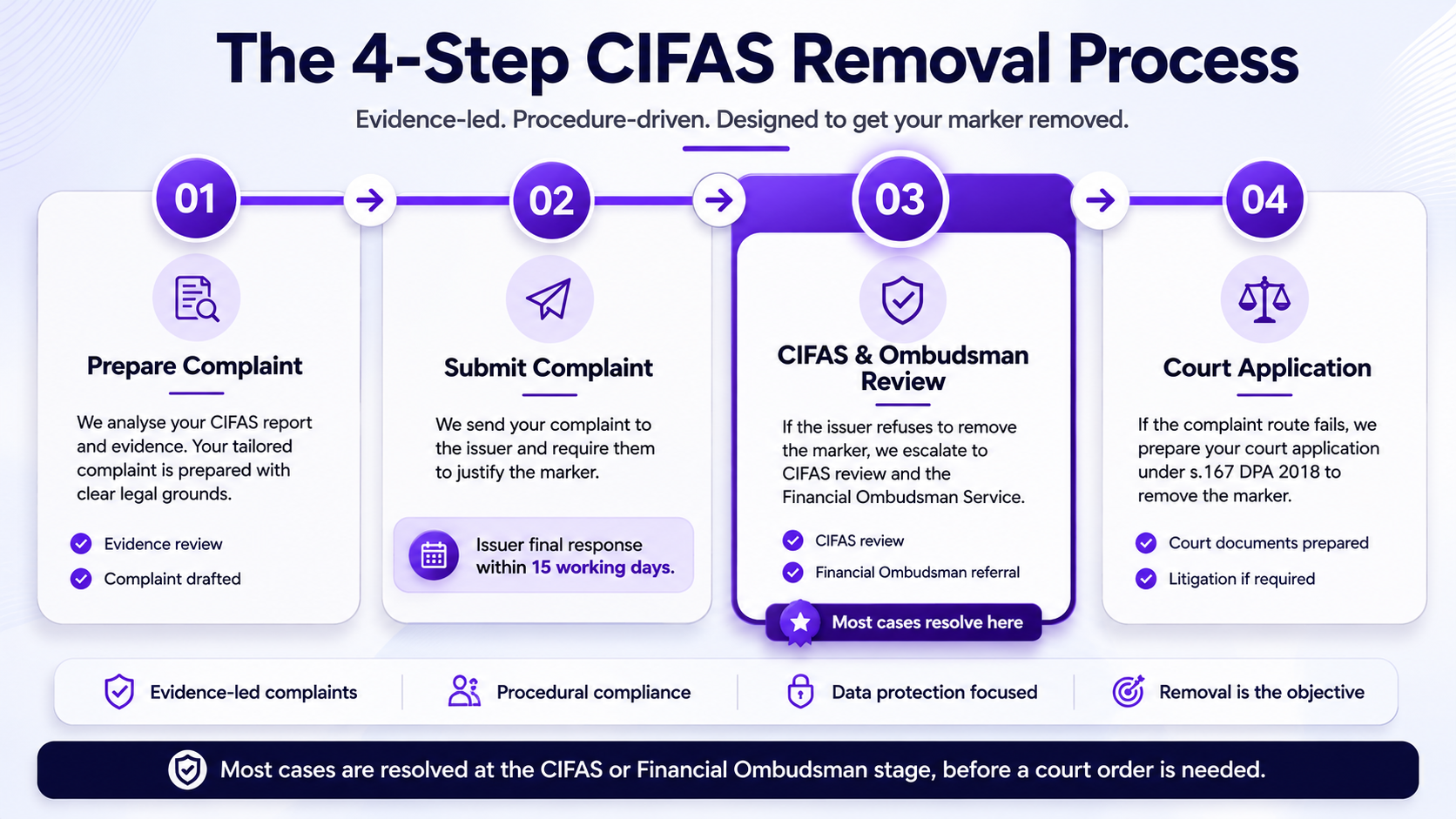
Practical route for a Barclays Bank marker
Get the record
Start with the Cifas entry and the institution's own file. Until the record is in view, the dispute is still mostly guesswork.
Challenge the filing
The first complaint goes to the organisation that loaded the warning and should test evidence, category choice, fairness, and data accuracy.
Escalate if the route is open
If the institution stands by the marker, the file can move to Cifas review and, where the route is available, to the Ombudsman.
Keep court in reserve
Very few disputes need to go that far, but the fact that the route exists changes how the earlier stages are handled.
Institution-specific notes
- For personal current-account, card, and retail banking complaints, the Ombudsman route is usually open once Barclays has issued its final response or the complaint deadline has passed.
- The public ICO register lists Barclays Bank Plc and gives the data protection contact as dpo@barclays.com, which is useful for record requests and accuracy challenges.
- If the case involves a broker, company structure, or third-party application, the complaint should pin down exactly who supplied the disputed information.
- Cifas review and Ombudsman escalation should be built around the same point. Barclays still has to show a proper basis for the filing, not just a reason to be suspicious.
Public data protection contact
The public ICO register lists Barclays Bank Plc as the relevant organisation for data protection purposes.
Case material
Barclays Bank case studies in the local record
Barclays case study
R's Barclays account was compromised through a SIM swap attack. Fraudulent transactions were carried out by the attacker. Barclays placed a Facility Takeover marker on R's CIFAS record, but recorded R as the suspect rather than the victim.
Key takeaway: Facility Takeover markers sometimes incorrectly flag the victim as the suspect. If you were the victim of account compromise (SIM swap, phishing, social engineering), the marker should be removed or reclassified. A police report significantly strengthens this argument.
Barclays Crypto Scam CIFAS Marker Removal
Cryptocurrency investment scam
Barclays Broker Fraud False Application CIFAS Marker Removal
Fraudulent mortgage broker
Barclays Binance P2P Trading CIFAS Marker Removal
Binance P2P cryptocurrency trading
Not upheld in the deduped published Ombudsman set
Unique published Ombudsman decisions in the local dataset
Archive entries tied to Barclays Bank
These figures are context rather than a verdict. In a Barclays Bank dispute, the real question is whether the filing actually met the evidence standard it was supposed to meet.
Barclays Bank CIFAS marker FAQ
How do I challenge a Barclays Bank CIFAS marker?+
Start by getting the Cifas record and the institution's own file, then complain to Barclays Bank about the filing itself: evidence, category choice, fairness, and data accuracy.
Does a Barclays Bank marker automatically mean fraud has been proved?+
No. A marker is a fraud-risk record filed by a member organisation, not a court finding. The dispute is whether Barclays Bank had a proper basis for loading it.
Can I go to the Ombudsman about a Barclays Bank marker?+
For personal retail-banking and e-money complaints, the Ombudsman route is usually available after a final response or once the complaint deadline has passed. Company-linked and director disputes can raise separate eligible-complainant issues.
What usually makes a Barclays Bank complaint stronger?+
A better complaint usually ties the scenario back to the record itself: who supplied the information, what the institution says was dishonest, what documents are missing, and whether the filing category actually fits what happened.
Start with the record, then build the complaint properly
If Barclays has filed a marker after crypto activity, a broker-led application, or business-account transactions, the first job is to test where Barclays says the dishonesty actually sits.