Skip to content
Financial Services4 local archive cases4 recurring scenarios

Halifax CIFAS marker removal

This page is for people trying to work out what a CIFAS warning from Halifax usually looks like, which scenario patterns keep resurfacing, and how the complaint route changes once the record is in front of you.

What a Halifax CIFAS marker usually looks like

Halifax files in the archive are a reminder that CIFAS disputes are not just about obvious mule recruitment. The scenarios range from building-work disputes and unexplained incoming money to passive-income schemes and crypto-linked transfers from other accounts.

That variety makes Halifax pages useful for customers who are not sure whether what happened to them was treated as fraud, a civil dispute, or a suspicious transfer pattern with very little explanation.

4

Published archive cases tied to Halifax

4

Recurring scenario patterns in the local record

1

Marker categories seen in the archive

Patterns in the Halifax archive

  • The archive includes construction and service disputes where Halifax appears to have treated a contested payment as a fraud problem.
  • Some Halifax cases involve funds arriving from other institutions after crypto activity elsewhere, which means the narrative is spread across more than one account.
  • Passive-income and influencer-style schemes also appear, showing a social-engineering element rather than a straightforward fraud conspiracy.
  • The archive is smaller than the Barclays or Revolut set, but the scenario mix is wide enough to justify a fact-specific page.

Where complaints against Halifax often focus

  • Civil or commercial disputes are a recurring pressure point because not every contested payment should become a fraud marker.
  • Where the transaction trail runs through another bank or exchange first, Halifax still has to show why its own filing was justified.
  • Scheme-based recruitment cases can be weak where Halifax relies on suspicion but does not show what the customer actually knew.
  • A Halifax complaint often works best when it narrows the issue to one question. Was this actually fraud, or did the bank overstate a disputed or unusual pattern?

Practical route for a Halifax marker

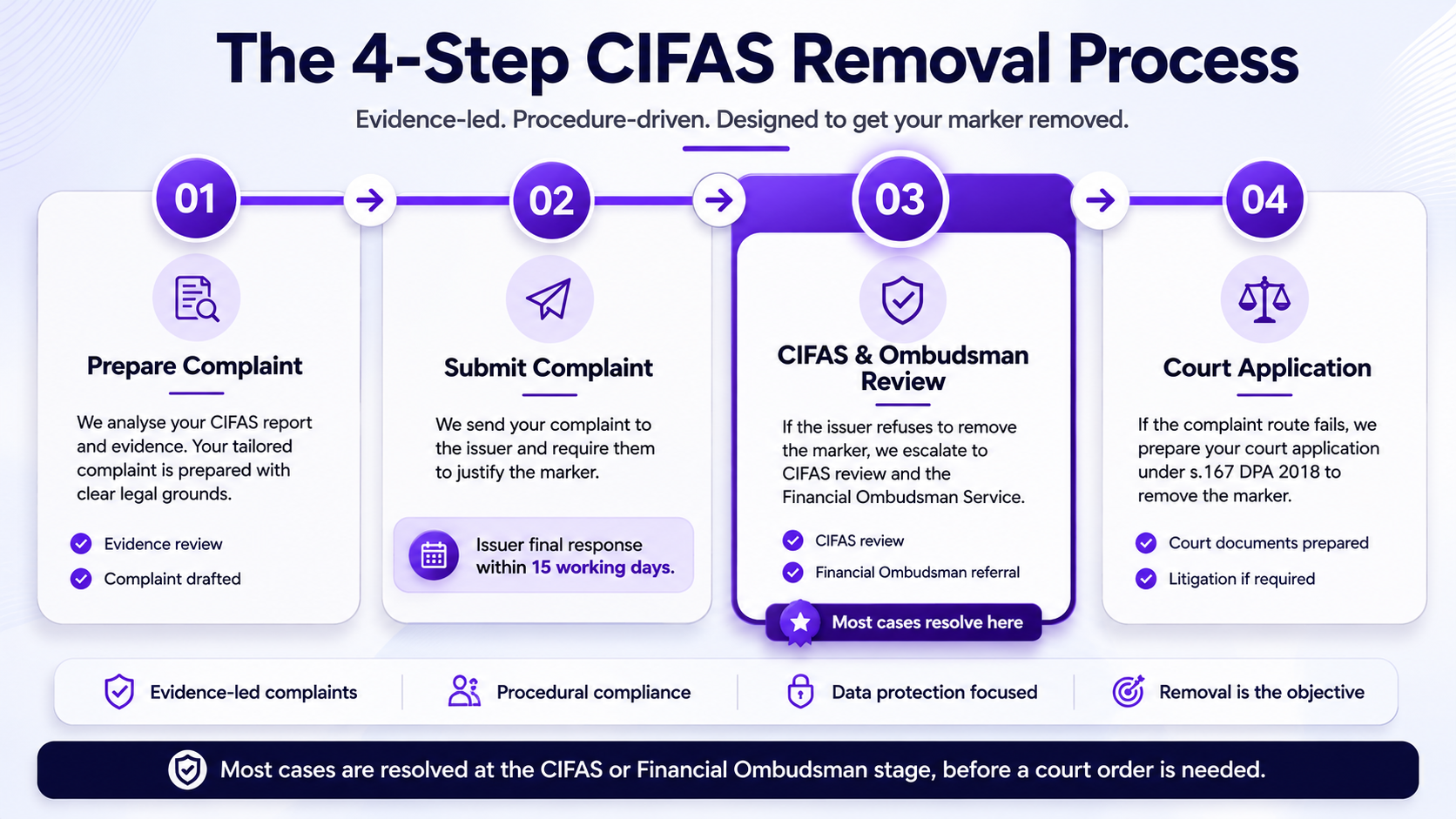
Step 01

Get the record

Start with the Cifas entry and the institution's own file. Until the record is in view, the dispute is still mostly guesswork.

Step 02

Challenge the filing

The first complaint goes to the organisation that loaded the warning and should test evidence, category choice, fairness, and data accuracy.

Step 03

Escalate if the route is open

If the institution stands by the marker, the file can move to Cifas review and, where the route is available, to the Ombudsman.

Step 04

Keep court in reserve

Very few disputes need to go that far, but the fact that the route exists changes how the earlier stages are handled.

Institution-specific notes

  • The ICO register ties Halifax back to Bank of Scotland Plc, which is useful when working out the formal data-controller details for record requests.
  • For personal retail-banking complaints, the Ombudsman route is usually open after a final response or once the complaint deadline has passed.
  • Halifax files often need the underlying commercial story explained properly because the bank's shorthand description may compress a longer dispute into a fraud label.
  • If another institution is part of the story, the complaint should still keep Halifax's filing separate and ask why Halifax itself said the marker standard was met.

Public data protection contact

The public ICO register lists Bank of Scotland Plc (trading as Halifax) as the relevant organisation for data protection purposes.

Case material

Halifax case studies in the local record

Flagship case studyFalse Application4 weeks

Halifax case study

A mortgage broker submitted information on P's behalf that P did not know was inaccurate. Halifax placed a False Application marker on P's record. P only discovered the marker when trying to remortgage elsewhere.

Key takeaway: When a broker prepared the application, make this clear in the complaint. The CIFAS marker should be filed against the party responsible for the false information, not necessarily the applicant.

71.3%

Not upheld in the deduped published Ombudsman set

1,313

Unique published Ombudsman decisions in the local dataset

4

Archive entries tied to Halifax

These figures are context rather than a verdict. In a Halifax dispute, the real question is whether the filing actually met the evidence standard it was supposed to meet.

Halifax CIFAS marker FAQ

How do I challenge a Halifax CIFAS marker?+

Start by getting the Cifas record and the institution's own file, then complain to Halifax about the filing itself: evidence, category choice, fairness, and data accuracy.

Does a Halifax marker automatically mean fraud has been proved?+

No. A marker is a fraud-risk record filed by a member organisation, not a court finding. The dispute is whether Halifax had a proper basis for loading it.

Can I go to the Ombudsman about a Halifax marker?+

For personal retail-banking and e-money complaints, the Ombudsman route is usually available after a final response or once the complaint deadline has passed. Company-linked and director disputes can raise separate eligible-complainant issues.

What usually makes a Halifax complaint stronger?+

A better complaint usually ties the scenario back to the record itself: who supplied the information, what the institution says was dishonest, what documents are missing, and whether the filing category actually fits what happened.

Start with the record, then build the complaint properly

If Halifax filed the marker after a disputed payment, a scheme sold through social media, or money arriving from crypto activity elsewhere, the complaint usually needs to test whether Halifax treated a messy situation as fraud without proving it.