
Skip to content
Issuer CIFAS marker

How to Challenge & Remove a Co-operative Bank CIFAS Marker

A Co-operative Bank CIFAS marker filed against your name can close your bank accounts, block your mortgage, and cost you your job, for up to six years unless you make a proper complaint. We have reviewed 1,657 Financial Ombudsman decisions and documented over 80 removals across 25+ UK institutions. We prepare every document your complaint needs, from the first request to the court bundle if it comes to that.

80+ Cifas Case Studies1,657 FOS decisions reviewedFast 15-Working-Day Timelines
CIFAS marker removal webinar and complaint support presentation.
Weekly live strategy webinars help you understand each response and next document.

Co-operative Bank

What Is A Co-operative Bank CIFAS Marker?

If Co-operative Bank has filed or may have filed a CIFAS marker after an account review, application, transaction dispute, payment investigation, or product closure, this page explains how the filing can be challenged using your CIFAS report, Co-operative Bank records, supporting evidence, and the correct escalation route.
Co-operative Bank

What Is A Co-operative Bank CIFAS Marker?

A Co-operative Bank CIFAS marker is a fraud-risk record connected to accounts, payments, onboarding, lending, or account review records. It is not a normal credit issue. It is a fraud-risk filing on the National Fraud Database and should be reviewed against the CIFAS category used, the records held by Co-operative Bank, and the evidence relied on when the marker was filed.

Research identifies The Co-operative Bank p.l.c. as the relevant legal entity for Co-operative Bank, trading as Co-operative Bank; smile; Britannia; Platform, company number 00990937, FCA reference 121885. Official Co-operative Bank and Coventry information says the bank joined the Coventry Building Society family on 1 January 2025 and the brands continue under separate banking licences during integration.

In a Co-operative Bank case, the marker may relate to:

  • Account opening information
  • Transaction monitoring or payment activity
  • Device, login, or access records
  • Source of funds or source of wealth questions
  • Account closure, restriction, or refusal decisions

The key point is simple. Co-operative Bank must be able to justify the marker with evidence, not suspicion, assumption, or a general account concern.

Co-operative Bank

Can A Co-operative Bank CIFAS Marker Be Removed?

Yes. A Co-operative Bank CIFAS marker can be removed if the filing cannot be properly justified. The issue is not simply whether Co-operative Bank had concerns. The issue is whether the evidence meets the required standard for a CIFAS marker.

We use the CIFAS Civil Dispute Framework to complain about:

  • Whether the correct CIFAS category was used
  • Whether Co-operative Bank had clear evidence of deliberate dishonesty
  • Whether the marker was based on evidence rather than suspicion
  • Whether innocent explanations, scams, pressure, vulnerability, or third-party involvement were considered
  • Whether the marker is accurate, fair, and lawful under data protection principles
  • Whether the marker should be removed, corrected, or restricted

You do not need to guess what to write. Upload your CIFAS report, Co-operative Bank records, and supporting evidence. We prepare the complaint documents needed to dispute the marker properly and guide the next stage if Co-operative Bank refuses to remove it.

Co-operative Bank

Need Help with Your Co-operative Bank Cifas Appeal?

If you don't have the time to navigate the complaints process or analyse complex DSAR files, our specialist team can review your case. We draft bespoke, evidence-backed appeal packages designed to meet CIFAS Principle 4 standards.

Co-operative Bank

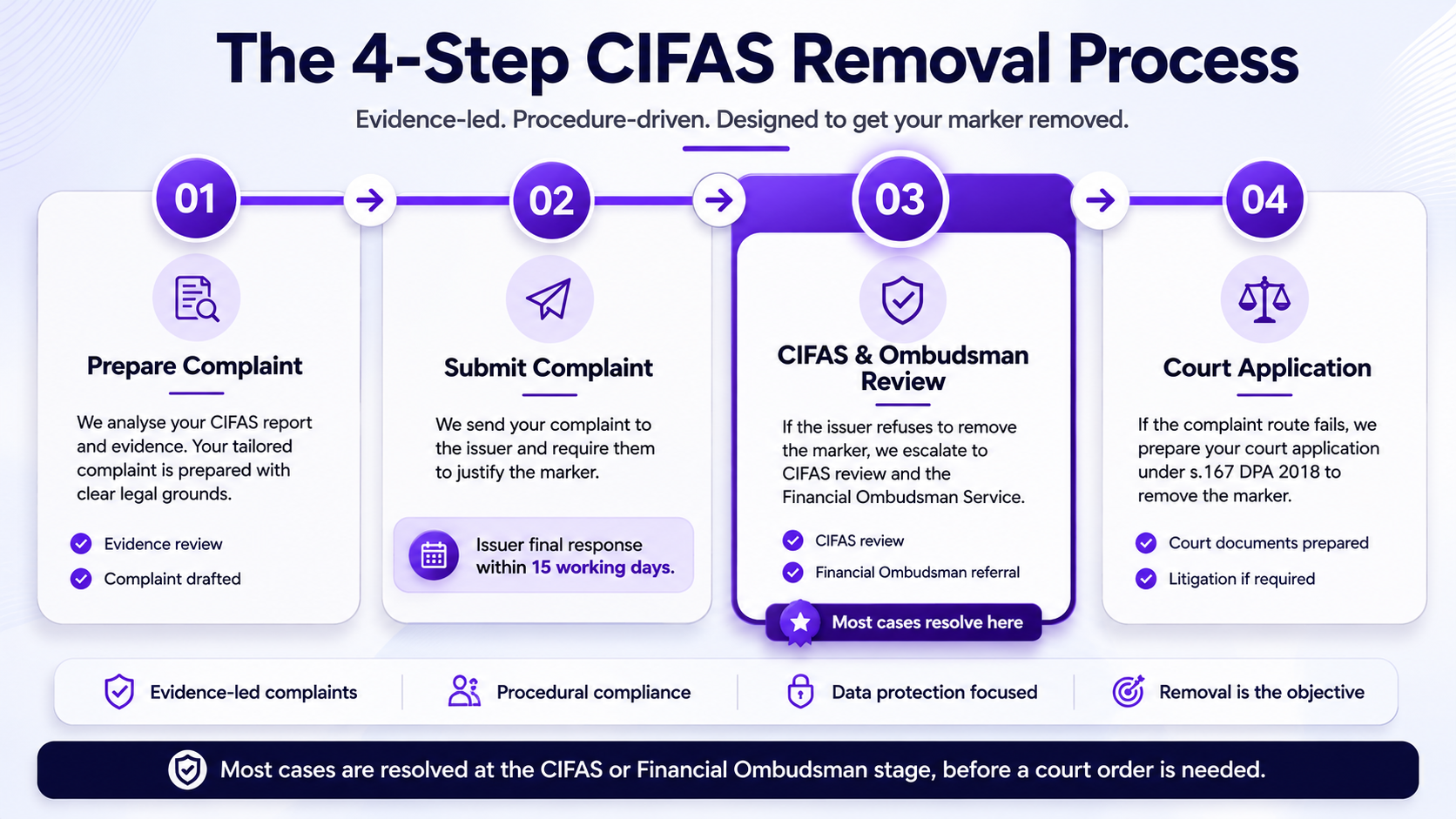
Co-operative Bank CIFAS Marker Removal Process

A Co-operative Bank CIFAS marker removal complaint should follow a clear process. The mistake most people make is sending a general complaint before they have the CIFAS report, issuer records, and supporting evidence in order.

CIFAS marker removal timeline

Do not send a generic, emotional complaint to Co-operative Bank. You must follow a structured, evidence-led escalation process.

The process usually works like this:

  • Request your CIFAS DSAR so you can confirm the marker, category, filing date, and filing organisation
  • Request your Co-operative Bank DSAR so you can see the records, application information, account material, product records, and fraud-review notes
  • Upload your CIFAS report, Co-operative Bank records, and supporting evidence to your case file
  • We prepare the complaint letter, evidence summary, removal request, and escalation plan
  • You submit the complaint to Co-operative Bank or the current trading entity responsible for the account
  • Co-operative Bank reviews the complaint and usually has up to 8 weeks to issue a Final Response Letter
  • If the marker is not removed, the case can be escalated to CIFAS and the Financial Ombudsman Service where appropriate

Bookmark this page or share it with anyone helping you. The aim is simple: get the record, build the evidence, submit the complaint properly, and escalate if Co-operative Bank does not remove the marker.

Co-operative Bank

CIFAS DSAR And Co-operative Bank DSAR

Before a Co-operative Bank CIFAS marker can be complained about properly, you need the records. The CIFAS DSAR shows what has been filed on the National Fraud Database. The Co-operative Bank DSAR helps identify what evidence the issuer relied on when the marker was filed.

You should request:

  • Your CIFAS report from CIFAS
  • Your account, application, product, or service records from Co-operative Bank
  • Fraud investigation notes, internal review notes, and any evidence relied on for the marker
  • Copies of correspondence, complaint notes, and closure, refusal, restriction, or product decision records
  • Any accounts, payments, onboarding, lending, or account review records used in the decision

The DSAR stage matters because it stops the complaint being based on guesswork. Once the records arrive, the marker can be reviewed against the category used, the evidence held, and whether the filing can be justified under CIFAS and data protection principles.

Co-operative Bank

Prepare Co-operative Bank Complaint

To prepare a strong Co-operative Bank complaint, the evidence needs to show what happened, why the marker is disputed, and what impact it has had. You do not need to write the complaint yourself. The job at this stage is to upload the right information so the complaint can be built properly.

Upload anything you have, including:

  • CIFAS DSAR report
  • Co-operative Bank DSAR response
  • Account opening or onboarding records
  • Payment and transfer records
  • Device, login, and access records
  • Fraud investigation notes
  • Account closure or restriction letters
  • Evidence of scam, coercion, third-party use, or identity fraud
  • A short explanation of what happened and why you say the marker is wrong or unfair

The more complete the upload, the stronger the complaint can be. We use the records to identify the marker category, the evidence problem, the data protection issues, and the practical impact of the marker before preparing the documents.

Co-operative Bank

Co-operative Bank Complaint Letter

The Co-operative Bank complaint letter should not be a generic removal request. It should be built around the CIFAS category, the issuer records, the evidence, and the reason the marker should not remain.

We prepare a structured complaint package that can include:

  • Formal complaint letter to Co-operative Bank or the current trading entity
  • Evidence summary
  • Marker removal request
  • Data accuracy and data protection arguments
  • Explanation of innocent circumstances, scam involvement, pressure, vulnerability, or third-party use where relevant
  • Impact summary covering banking, credit, employment, mortgage, or personal consequences
  • Escalation roadmap if the complaint is rejected

The complaint is designed to make Co-operative Bank address the core issue: whether the marker is supported by clear evidence, the correct category, and a lawful basis for continued processing. If the evidence does not justify the marker, the complaint should ask for removal, correction, or restriction.

Co-operative Bank

Submit Your Complaint To Co-operative Bank

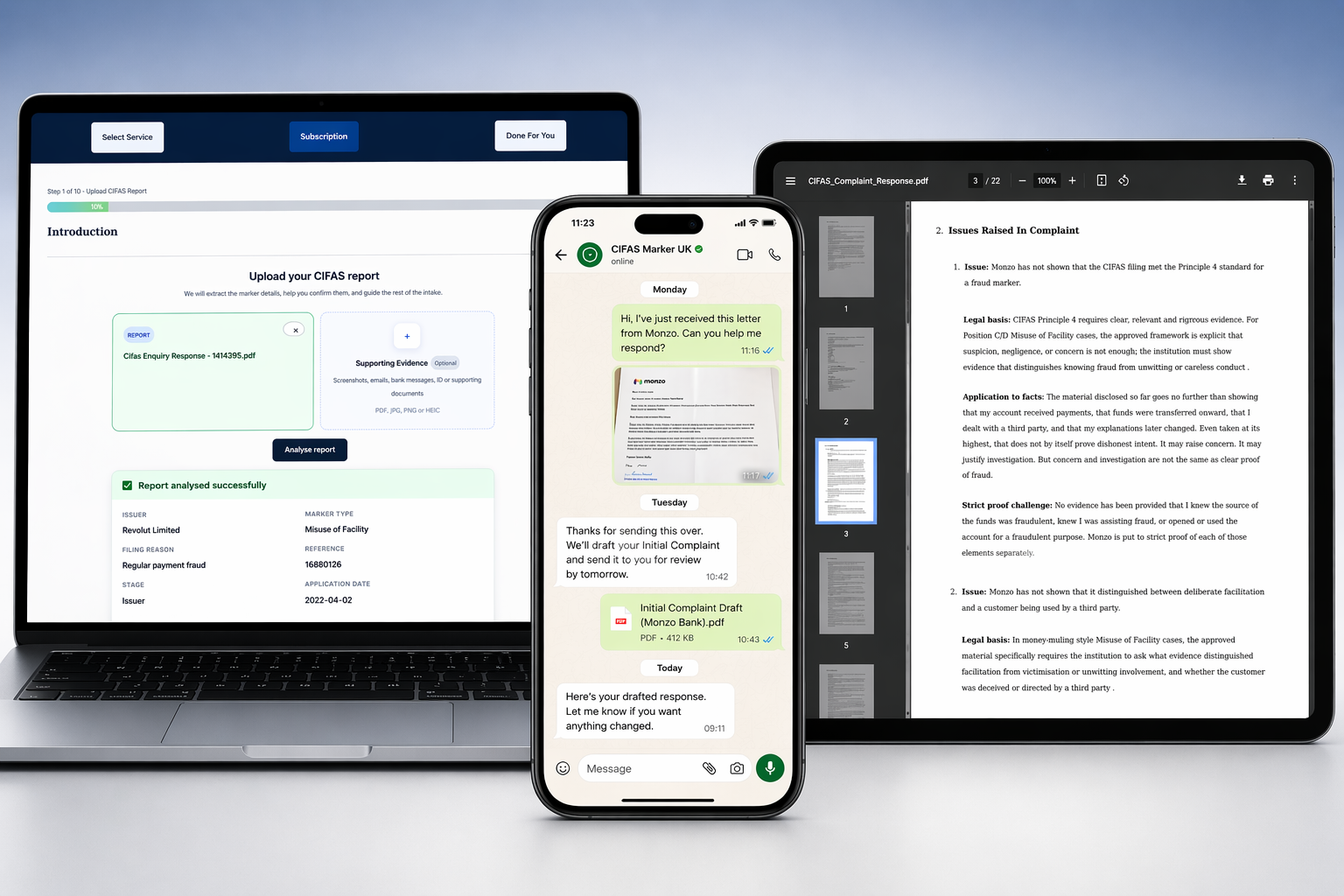
Once your complaint package is ready, we send you a ready-to-send email for Co-operative Bank or the current trading entity responsible for the account. Where verified contact information is available, we include it with the complaint. If a direct complaint contact is not available, we explain how to find the correct firm and complaint details on the FCA Register.

Official feedback and complaints route; verify product and whether Co-operative Bank, smile, Britannia, Platform, or Coventry group route applies. Useful links: complaints page, privacy notice, contact page, FCA Register.

CIFAS marker complaint support across devices

Cifas Removal Support

Co-operative Bank must respond within the relevant complaint deadline. Your letter must be strictly factual, evidence-led, and tied to the CIFAS category and data protection issues. If you are unsure how to structure your evidence, we can prepare a bespoke Co-operative Bank complaint letter for you.

The ready-to-send complaint email can include:

  • Your formal Co-operative Bank complaint letter
  • Evidence summary
  • Marker removal request
  • Supporting documents
  • Instructions on where to send the complaint
  • Guidance on checking the FCA Register if contact details need to be confirmed

After the complaint is submitted, Co-operative Bank should acknowledge the complaint and investigate the issues raised. The issuer will usually have up to 8 weeks to provide a Final Response Letter.

As a subscriber, you also get access to our weekly CIFAS Removal Workshops and AI assistant support. This helps you understand replies from Co-operative Bank, respond carefully to requests for more information, and avoid making mistakes that could weaken the complaint.

Co-operative Bank

Co-operative Bank Final Response

After your complaint is submitted, Co-operative Bank should investigate the marker, review the evidence, and explain whether it will remove, correct, restrict, or maintain the CIFAS filing.

The Final Response Letter should explain:

  • The decision reached by Co-operative Bank
  • The evidence it says supports the marker
  • The CIFAS category relied on
  • Whether the marker will be removed, corrected, restricted, or maintained
  • Your right to escalate the complaint if you remain dissatisfied

Do not treat a refusal as the end of the process. The Final Response Letter is an important document because it shows the reasons Co-operative Bank is relying on. If the marker is not removed, upload the Final Response Letter to your case file so the next stage can be reviewed and prepared.

Co-operative Bank

Escalate Co-operative Bank CIFAS Marker

If Co-operative Bank refuses to remove the marker, upload the Final Response Letter to your case file. Once we have reviewed the response, we prepare the documents needed to escalate the complaint to the Financial Ombudsman Service and CIFAS.

Financial Ombudsman Service

We prepare the Ombudsman complaint so you can register the dispute without starting again from scratch. In most cases, you simply forward the prepared email and documents to the Financial Ombudsman Service.

We prepare:

  • Ombudsman complaint form
  • Summary of what happened
  • Response to Co-operative Bank's Final Response Letter
  • Evidence summary
  • Explanation of the marker impact
  • Supporting documents list
  • Draft email to send to the Ombudsman

The Financial Ombudsman Service reviews whether Co-operative Bank acted fairly and reasonably. It may consider the evidence relied on by the issuer, your explanation, complaint handling, supporting documents, and whether maintaining the marker is fair.

Financial Ombudsman Representation

The Ombudsman will review the case completely afresh. To maximise your chances, your submission must clearly highlight how Co-operative Bank failed to meet the Standard of Proof. Learn how our FOS Escalation Service handles the legal jargon for you.

CIFAS Review

We also prepare the information needed for the CIFAS online complaints form. This helps keep the CIFAS review focused on the marker category, the evidence, and whether the filing meets the standards required for the National Fraud Database.

We prepare:

  • CIFAS review comments
  • Answers for the CIFAS online form
  • Summary of the marker dispute
  • Response to Co-operative Bank's reasons for refusal
  • Evidence summary
  • Explanation of why the marker should be removed, corrected, or restricted
  • Practical script for completing the CIFAS complaint form

CIFAS reviews whether the marker meets the standards required for inclusion on the National Fraud Database. It may consider the category used, the information supplied by Co-operative Bank, whether CIFAS principles were followed, and whether the issuer has justified keeping the marker in place.

Co-operative Bank

Expected Outcomes Of A Co-operative Bank CIFAS Marker Complaint

A Co-operative Bank CIFAS marker complaint can have different outcomes depending on the evidence, the category used, and how Co-operative Bank responds to the complaint.

Possible outcomes include:

  • The marker is removed
  • The marker is corrected
  • The marker is restricted
  • Co-operative Bank maintains the marker and explains why
  • CIFAS asks for more information before completing its review
  • The Financial Ombudsman Service asks further questions
  • The Ombudsman recommends or requires removal
  • Compensation is awarded for distress, inconvenience, financial impact, or other relevant loss

The goal is to make Co-operative Bank justify the marker properly. If the evidence does not support the CIFAS category, or if the marker is inaccurate, unfair, or disproportionate, removal or correction should be requested.

If compensation is awarded by the Financial Ombudsman Service, it is paid directly to you. We do not charge a success fee and we do not take a percentage of any compensation awarded.

Co-operative Bank

Co-operative Bank CIFAS Marker Removal Pricing

Guided support

CIFAS Documents

Prepared complaint documents, weekly live webinars, WhatsApp support, and 24/7 AI support while you manage submission yourself.

£149.99/ month
Start CIFAS Documents
Most popular

CIFAS Representation

Managed complaint strategy, evidence review, issuer complaint, CIFAS review, and FOS referral support.

£1,500one-off
Start CIFAS Representation
Advanced route

CIFAS Court Order

Letter of Claim, Particulars of Claim, witness statement, exhibits, and Litigant in Person court-stage document support.

£5,000one-off
Start CIFAS Court Order

Cifas Service Comparison

Feature / Support Level1. DIY Route2. Guided Support (Monthly)3. Done For You (Bespoke)
Document DraftingManual, hours of researchInstant autonomous generationComplete document package
Strategy & SupportNone, forums onlyWeekly Live Webinars & 24/7 AIDirect 1-to-1 consultation
Target TimelinesUntrackedTracked via platform dashboardManaged escalation workflow
PricingFree£149.99 / month, cancel anytimeFixed one-off fee

Assess your Cifas Marker

  • Take our 2-Minute CIFAS Assessment to see if your Co-operative Bank marker can be legally challenged.
  • Fixed-Fee Document Preparation.
  • Case Merits Assessment.

Issuer questions

Co-operative Bank CIFAS Marker FAQs

What is a Co-operative Bank CIFAS marker?+

A Co-operative Bank CIFAS marker is a fraud-risk record connected to accounts, payments, onboarding, lending, or account review records. It may affect banking, credit, mortgage applications, employment screening, and other financial services.

Can a Co-operative Bank CIFAS marker be removed?+

Yes. A Co-operative Bank CIFAS marker can be removed if the filing cannot be properly justified. The complaint needs to address the evidence, the marker category, and whether the marker is accurate, fair, and lawful under data protection principles.

How do I start removing a Co-operative Bank CIFAS marker?+

Start by requesting your CIFAS DSAR and gathering any records you have from Co-operative Bank. Then upload your CIFAS report, issuer records, supporting evidence, and a short explanation of what happened so the complaint package can be prepared.

What evidence do I need for a Co-operative Bank CIFAS marker complaint?+

Useful evidence may include your CIFAS report, Co-operative Bank DSAR response, account or product records, correspondence, screenshots, transaction records, fraud reports, refusal letters, and evidence showing the impact of the marker.

How long does Co-operative Bank have to respond?+

After the complaint is submitted, Co-operative Bank will usually have up to 8 weeks to investigate and issue a Final Response Letter. If no proper final response is received, or if the marker is maintained, the case may be ready for escalation.

What happens if Co-operative Bank refuses to remove the marker?+

If Co-operative Bank refuses removal, upload the Final Response Letter to your case file. We can then prepare the Financial Ombudsman complaint documents and CIFAS review responses so the matter can be escalated.

Can the Financial Ombudsman remove a Co-operative Bank CIFAS marker?+

The Financial Ombudsman Service can require an issuer to remove or correct a marker where it decides the firm acted unfairly or unreasonably. It may also award compensation where appropriate.

Can CIFAS remove a Co-operative Bank marker?+

CIFAS can review whether the marker meets the standards required for inclusion on the National Fraud Database. If the filing is not properly justified, CIFAS may require the issuer to amend or remove it.

Do I need to write the complaint letter myself?+

No. Once you upload your CIFAS report, Co-operative Bank records, and supporting evidence, we prepare the complaint letter, evidence summary, removal request, and escalation roadmap for you.

Do you take a percentage of compensation?+

No. If compensation is awarded by the Financial Ombudsman Service or another route, it is paid directly to you. We do not charge a success fee and we do not take a percentage of your compensation.

CIFAS marker removal guide preview

Free self-paced guide

Read the Free CIFAS Civil Dispute Framework Guide

Understand the evidence route before choosing how to challenge a Co-operative Bank CIFAS marker. The guide explains DSARs, issuer evidence, complaints, CIFAS review, FOS referral, and court-stage documents.

Self-pacedNo webinarDocument-led

The guide explains the process. Personalised document preparation begins after package selection.

CIFAS marker types

Check the marker category

Back to NFD members

Misuse of Facility

MOF

A Misuse of Facility marker usually means an organisation believes your own account or facility was used in suspicious or fraudulent activity, such as receiving or moving suspicious funds.

Learn more

False Application

FA

False Application usually means an organisation believes false information or documents were used in an application for a financial product or service.

Learn more

Facility Takeover

FT

Facility Takeover usually means an account or financial facility was taken over or used by someone without proper authority.

Learn more

Identity Fraud

IF

Identity Fraud usually means identity details were used to obtain a product or service fraudulently, sometimes affecting the victim if the marker is filed incorrectly.

Learn more

Asset Conversion

AC

Asset Conversion usually involves financed or leased goods being sold, retained, or not returned in a way the organisation says was dishonest.

Learn more

False Insurance Claim

FIC

False Insurance Claim usually means an insurer says an insurance claim involved a material falsehood, exaggeration, or false supporting information.

Learn more

Expert bio

Leo Musami

Civil Disputes Specialist with 7+ years' experience, former Accenture consultant, C2FO project manager, and Professional Representative for CIFAS Marker UK clients. Leo has helped thousands of consumers prepare dispute documents, complaints, and court-stage case files across civil and financial disputes.

Where clients choose representation, Leo acts as a Professional Representative, helping manage issuer complaints, CIFAS review, and Financial Ombudsman escalation.

View Leo Musami on LinkedIn

Legal Disclaimer

CIFAS Marker UK is a trading name of Civil Disputes UK Limited. We prepare complaint documents and manage the CIFAS Civil Dispute Framework. We are not a law firm, are not regulated by the SRA, and are not a Claims Management Company. Complaint Representation clients are supported as professional representatives consistent with FOS guidance on professional representatives. Court stage clients stand as Litigant in Person in accordance with the Civil Procedure Rules.

Specialist CIFAS marker removal firm

Challenge Your Co-operative Bank CIFAS Marker

Professionally drafted complaint documents built around your marker, issuer, and evidence. We manage the process at every stage where your package includes representation.