Skip to content
Financial Services14 local archive cases14 recurring scenarios

Revolut CIFAS marker removal

This page is for people trying to work out what a CIFAS warning from Revolut usually looks like, which scenario patterns keep resurfacing, and how the complaint route changes once the record is in front of you.

What a Revolut CIFAS marker usually looks like

Revolut files dominate the local archive because the same scenario cluster keeps resurfacing: Telegram work offers, social-engineering recruitment, friends using the account, and payment flows that were treated as obvious fraud by the time the account holder realised anything was wrong.

The common thread is speed. Revolut cases often look like reactive filing based on unusual movement through the account rather than a documented explanation of why the account holder was dishonest.

14

Published archive cases tied to Revolut

14

Recurring scenario patterns in the local record

1

Marker categories seen in the archive

Patterns in the Revolut archive

  • Telegram and WhatsApp job scams appear repeatedly, often with modest sums and short-lived activity that was still enough to trigger a marker.
  • Friend-and-family payment cases are common, especially where the account holder says they were helping somebody they trusted rather than hiding criminal activity.
  • Task schemes, fake part-time jobs, and social-engineering recruitment show up more than formal investment or lending disputes.
  • Almost every Revolut case in the local archive is a Misuse of Facility filing rather than a broader spread of marker types.

Scenario labels we keep seeing

Telegram job scamFriend used account for paymentsFriend payments reassuranceTask and video liking schemeFriend payment support turned suspiciousCrypto trading with trusted friendIndian friend currency exchangeSocial engineering scam victim
Misuse of Facility

Where complaints against Revolut often focus

  • The complaint pressure point is usually dishonesty. Revolut may have identified suspicious traffic, but the dispute is whether the customer knew what they were participating in.
  • A second weakness is the jump from internal monitoring to a fraud filing without much visible human explanation in the record.
  • Victim-status evidence can be powerful in Revolut files because many of the underlying stories are really social-engineering or mule-recruitment cases.
  • Where the amount involved is small, a proportionality argument often helps show how severe the consequence is compared with the proven conduct.

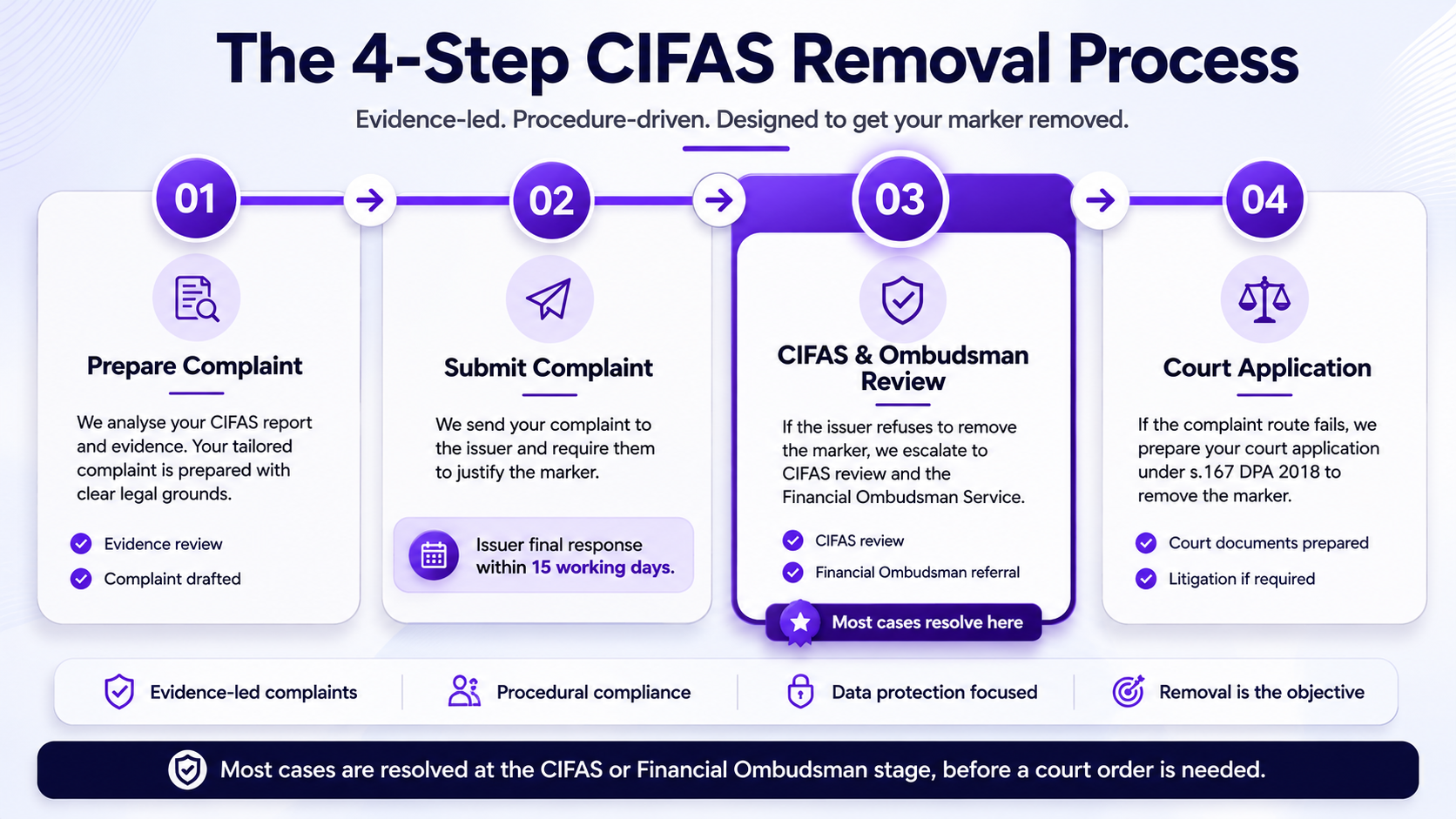
Practical route for a Revolut marker

Step 01

Get the record

Start with the Cifas entry and the institution's own file. Until the record is in view, the dispute is still mostly guesswork.

Step 02

Challenge the filing

The first complaint goes to the organisation that loaded the warning and should test evidence, category choice, fairness, and data accuracy.

Step 03

Escalate if the route is open

If the institution stands by the marker, the file can move to Cifas review and, where the route is available, to the Ombudsman.

Step 04

Keep court in reserve

Very few disputes need to go that far, but the fact that the route exists changes how the earlier stages are handled.

Institution-specific notes

  • Revolut complaints often need a tightly organised chronology because the customer usually discovered the marker only after later account declines.
  • The ICO register lists Revolut Ltd with the public data protection email dpo@revolut.com, which is useful for record requests alongside the complaint.
  • For retail customers, the Ombudsman route is usually relevant after Revolut has issued its final response or the complaint time limit has passed.
  • The strongest Revolut complaints usually combine the account narrative, the CIFAS record, and any screenshots showing how the person was recruited or reassured.

Public data protection contact

The public ICO register lists Revolut Ltd as the relevant organisation for data protection purposes.

Email: dpo@revolut.com

Address: 30 South Colonnade, London

View the ICO entry

Case material

Revolut case studies in the local record

Flagship case studyMisuse of Facility3 days

Revolut case study

D's Revolut account received a series of payments from contacts that Revolut flagged as suspicious. The account was frozen and closed, and a CIFAS Misuse of Facility marker was placed on D's record without prior notification. D discovered the marker when trying to open a bank account elsewhere and was declined.

Key takeaway: Many Misuse of Facility markers are placed reactively when suspicious transactions are detected, without proper investigation into whether the account holder acted dishonestly. A structured complaint that challenges the standard of proof can resolve these quickly.

71.3%

Not upheld in the deduped published Ombudsman set

1,313

Unique published Ombudsman decisions in the local dataset

14

Archive entries tied to Revolut

These figures are context rather than a verdict. In a Revolut dispute, the real question is whether the filing actually met the evidence standard it was supposed to meet.

Revolut CIFAS marker FAQ

How do I challenge a Revolut CIFAS marker?+

Start by getting the Cifas record and the institution's own file, then complain to Revolut about the filing itself: evidence, category choice, fairness, and data accuracy.

Does a Revolut marker automatically mean fraud has been proved?+

No. A marker is a fraud-risk record filed by a member organisation, not a court finding. The dispute is whether Revolut had a proper basis for loading it.

Can I go to the Ombudsman about a Revolut marker?+

For personal retail-banking and e-money complaints, the Ombudsman route is usually available after a final response or once the complaint deadline has passed. Company-linked and director disputes can raise separate eligible-complainant issues.

What usually makes a Revolut complaint stronger?+

A better complaint usually ties the scenario back to the record itself: who supplied the information, what the institution says was dishonest, what documents are missing, and whether the filing category actually fits what happened.

Start with the record, then build the complaint properly

If Revolut filed the marker after a Telegram job, a friend using the account, or suspicious incoming payments, the real question is whether Revolut can prove you acted dishonestly rather than getting caught in somebody else's scheme.